


Executive Certificate in AI-Enabled People Strategy and Analytics
Lead people transformation with AI and workforce insight
Build the strategic capabilities to lead responsible AI adoption, strengthen people analytics and translate workforce data into strategic action with the Executive Certificate in AI-Enabled People Strategy and Analytics learning journey from Cambridge Judge Business School Executive Education.

Why choose this multiprogramme learning journey?
The Executive Certificate in AI-Enabled People Strategy and Analytics is a strategic online learning journey from Cambridge Judge Business School Executive Education. The programme is designed for HR professionals, people leaders like you and business leaders, helping you navigate AI’s role in workplaces and talent systems. It also enables you to leverage people data more effectively to make informed workforce decisions and drive measurable impact.
This online learning journey brings together two people-based programmes: People Strategy in the Age of AI, which focuses on responsible AI adoption, work redesign, talent systems and governance, and People Analytics: Transforming HR Strategy with Data Science, which builds capabilities in organisational data, psychometrics, predictive modelling and evidence-based decision-making.
The multiprogramme learning journey offers a combined practical learning experience that helps to translate workforce insights into actionable results. You will develop strategic people analytics capabilities to identify opportunities, address workforce challenges, strengthen workforce planning and support stronger business outcomes.
What will the multiprogramme learning experience be like?

Faculty live sessions
Participate in live sessions on AI, workforce and analytics challenges, focused on practical application and strategic decision-making.

Hands-on activities
Engage in employee journey mapping, value–risk–trust assessments and skills-based role design.

Practical AI exposure
Learn predictive, generative and agentic AI through workforce applications via real-world examples and decision-making frameworks.

Research-backed methods
Analyse performance drivers, experiment with workplace data and solve root causes of HR challenges.

Collaborative learning
Interact with global peers to exchange insights, explore diverse case studies and broaden your perspective.

Practical strategies
Build, structure and lead an effective people analytics function using strategies curated by Cambridge Judge Business School faculty.

Strategic and technical tools
Transform people data into insights that drive smarter, evidence-based business and workforce decisions.

People analytics tools
Access analytical frameworks, psychometric tools and predictive modelling approaches to interpret workforce data and support evidence-based decisions.

A transformation playbook
Develop a practical road map that helps connect AI opportunities, workforce strategy and responsible adoption.

Leadership frameworks
Facilitate workforce transformation, governance and human–AI collaboration through ethical, behavioural and data-led decision-making.

Real-world case studies
Study real-world industrial examples that illustrate how organisations are applying AI, analytics and workforce strategies in practice.
What will you learn in the multiprogramme journey?
Key takeaways
People Strategy in the Age of AI
Strategic alignment: align AI adoption with business strategy and talent management to drive organisational transformation.
AI prioritisation: identify and prioritise high-impact AI use cases across HR while balancing value creation, ethics and compliance.
AI-based talent systems: design AI-enabled talent systems that improve outcomes while protecting fairness, transparency and trust.
Work redesign: redesign work, roles and decision rights for effective human–AI collaboration while protecting employee agency, autonomy and psychological safety.
Workforce strategy: build workforce strategies that prepare your organisation for long-term AI adoption.
Responsible governance: implement governance, cultural and change mechanisms for responsible and sustainable AI adoption and workforce well-being.
People Analytics: Transforming HR Strategy with Data Science
Function setup: establish the setup and define the mission of a people analytics function.
Strategy translation: translate organisational strategy into effective people analytics initiatives using stakeholder insights and data.
Root cause: identify the root causes of people’s challenges to align problems with appropriate solutions.
Stress-test experiments: design people analytics experiments to test hypotheses and generate actionable insights.
Psychometric tools: apply psychometric tools to enhance people analytics and support decision-making.
Data analysis: leverage data to analyse past trends, interpret current conditions and predict future outcomes.
Evidence-based action: recommend evidence-based organisational actions informed by predictive modelling.
Responsible use: promote the responsible and ethical use of people analytics within organisational and societal contexts.
How is the multiprogramme curriculum structured?
The multiprogramme learning journey is structured in two parts, combining AI-enabled people strategy with people analytics to help you build the strategic and analytical capabilities to lead responsible workforce transformation.
1
People Strategy in the Age of AI
Strategic AI Foundations for HR Leaders
Responsible AI in Hiring and Talent Acquisition
AI-Powered Talent Management — Performance, Growth and Mobility
The AI-Driven Workplace — Human–AI Collaboration and Work Redesign
AI-First Workforce Strategy — Skills, Capability and Transitions
Leading Responsible AI Transformation — Governance, Culture and Sustainable Adoption
2
People Analytics: Transforming HR Strategy with Data Science
Strategic Positioning
Leveraging Internal Resources
Root Cause Analysis and Project Tactics
Experiment Design for People Analytics
Psychometric Testing
Organisational Data Science 1
Organisational Data Science 2
Transforming the Workplace
Faculty live sessions
Engage with Cambridge Judge Business School faculty through a series of live, interactive sessions designed to extend your understanding of key people analytics concepts and explore their application in real-world settings. These sessions cover advanced topics, including root cause analysis, psychometric integration, predictive analytics and strategic planning for workplace transformation.
You will examine real cases, gain expert perspectives and take part in guided discussions to strengthen your ability to lead analytics initiatives effectively. You will also learn to:
Solve the right HR problems using root cause analysis and project prioritisation
Understand the role of psychometric data and latent traits in workplace behaviour
Apply organisational data science from description to prediction
Develop a people analytics vision to guide strategic workplace change
How does the multiprogramme journey use applied learning?
Case studies

Capital One
Examine Capital One’s centralised approach to AI enablement and what it reveals about enterprise AI governance and operating models.

Unilever
Discover how Unilever uses AI to connect HR processes, skills and talent decisions across the employee life cycle.

Siemens Energy
Assess how Siemens Energy's AI Champions can build organisational capability and accelerate the adoption of responsible AI.

JPMorgan Chase
Examine how AI-supported evidence and data stewardship can strengthen people decisions, improve accountability and enhance organisational capability.

Microsoft
Explore how Microsoft’s AI-enabled workplace tools and research provide insights on productivity, workforce capability and employee experience.

Vodafone
See how Vodafone uses skills-based approaches to hiring and internal mobility to connect people with new opportunities.

KPMG
Examine how incentives can encourage employees to experiment with and adopt AI in ways that support organisational transformation.

Walmart
Understand how Walmart translates AI-enabled productivity into customer value and redesigned employee roles.

IBM
Consider how IBM uses AI-enabled solutions, including AskHR, to support employees, skills intelligence and talent experiences.

SAP
Explore how SAP approaches decentralised AI enablement and the governance of generative AI use cases.

Strategic AI and People Transformation Playbook
Develop a Strategic AI and People Transformation Playbook that integrates the outputs from every module into a practical transformation road map for your organisation. The playbook includes the following:
AI Opportunity Blueprint
Future-State AI Hiring Operating Model
Future-State AI Talent System
Human–AI Work Redesign Plan
AI-First Workforce Strategy
Responsible AI Transformation Road Map
Practical tools and frameworks
Gartner IT maturity model
This structured benchmarking tool is used to assess and advance IT and analytics capabilities across functions, including Chief Information Officer (CIO) leadership, infrastructure and operations and enterprise data strategy.
Gartner talent analytics framework
Designed to embed analytics into daily HR workflows, this framework supports evidence-based decision-making across the employee life cycle — from talent acquisition to retention and development.
Gartner corporate performance management framework
This comprehensive model links business strategy with performance metrics, enabling organisations to align planning, forecasting and reporting with advanced analytical tools.
Orpheus Business Personality Inventory (OBPI)
Developed by Professor John Rust at the Cambridge Psychometrics Centre, this scientifically validated tool assesses workplace traits and integrity. Participants receive a personal report, offering practical insight into the use of psychometric testing for recruitment, coaching and organisational development.
STAR(L) interview model and TOTE scheme
This behavioural interview method helps structure conversations to extract actionable information from candidates and employees, enabling more effective analysis of qualitative input.
Text analysis — video demonstration
This guided demonstration using Jupyter Notebook shows how to process and interpret unstructured text data for actionable insights in HR contexts.
Predictive model analysis — video demonstration
This video demonstration is a step-by-step walkthrough of a predictive modelling exercise designed to help participants understand how to build and interpret forecasting models based on organisational data.
Who is this multiprogramme journey for?
Senior HR and people leaders | Align people strategy with responsible AI adoption and strengthen evidence-based workforce decisions. |
People analytics and HR professionals | Move beyond reporting by connecting analytical insight with workforce strategy and action. |
Business leaders and employee representatives | Understand how AI, data-driven work practices and workforce change affect roles, talent systems and employee experience. |
Consultants, transformation specialists and cross-functional leaders | Build the strategic framing and analytical fluency needed to support people and workforce transformation. |
Policy and governance professionals | Guide responsible AI adoption through fairness, trust, accountability and sustainable workforce change. |
Meet the faculty for the Executive Certificate in AI-Enabled People Strategy and Analytics
The Executive Certificate in AI-Enabled People Strategy and Analytics brings together faculty and experts from both constituent programmes, combining expertise in AI and people strategy, organisational transformation, people analytics and data science to help you successfully navigate the changing world of work.

Luning Sun
Research Director, BSc (Zhejiang University), MSc (University of Munich), PhD (University of Cambridge)

Peter Romero
People Analytics Lead, The Psychometrics Centre

Lionel Paolella
Professor of the Social Sciences and Organisations, Cambridge Judge Business School

Smaranda Gosa-Mensing
Executive Coach and Faculty Fellow, Cambridge Judge Business School

Elizabeth Osta
Data and AI transformation leader and Visiting Fellow, Cambridge Judge Business School
Certificate
Upon successful completion of this learning journey, you will receive three digital certificates of completion from Cambridge Judge Business School Executive Education for the People Analytics: Transforming HR Strategy with Data Science programme, the People Strategy in the Age of AI programme and the Executive Certificate in AI-Enabled People Strategy and Analytics multiprogramme learning journey.
Please note that this programme can be incorporated into the completion of the Cambridge General Management Certificate of Achievement (GMCA). It will be credited as an in-person four-day programme for the purpose of meeting the GMCA requirements. If you require more details on the GMCA and wish to speak to our advisers, please contact executive.education@jbs.cam.ac.uk.
Please note that this programme can be incorporated into the completion of the Cambridge General Management Certificate of Achievement (GMCA). It will be credited as an in-person four-day programme for the purpose of meeting the GMCA requirements. If you require more details on the GMCA and wish to speak to our advisers, please contact executive.education@jbs.cam.ac.uk.
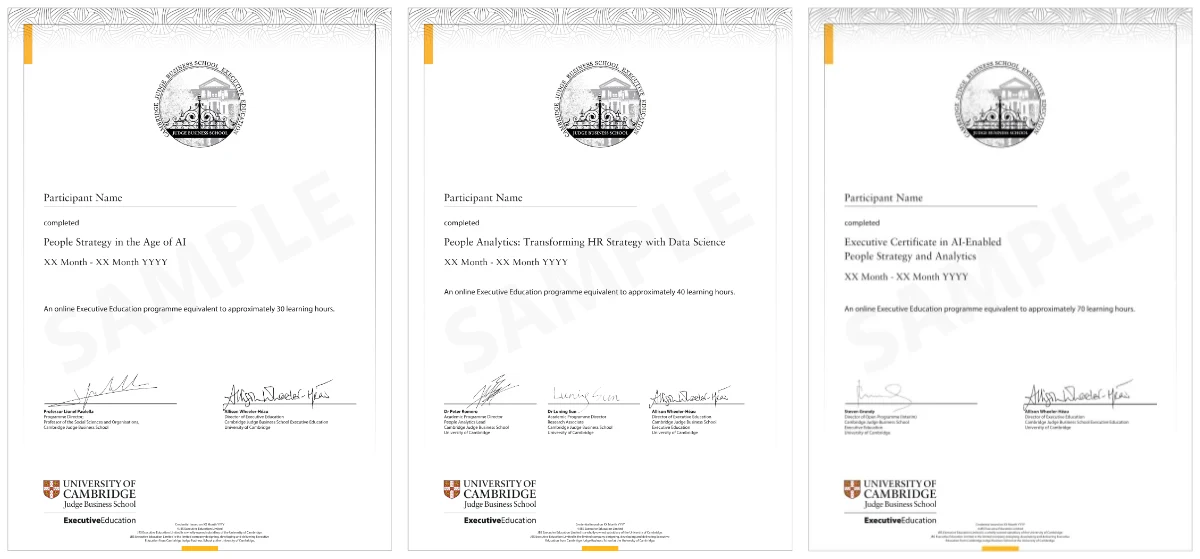
Note: after successful completion of the online programme, your verified digital certificates will be emailed to you in the name you used when registering for the programme. All certificate images are for illustrative purposes and may be subject to change at the discretion of Cambridge Judge Business School Executive Education.
FAQs
1
The programme
How do I know if this programme is right for me?
The Executive Certificate in AI-Enabled People Strategy and Analytics is designed for HR managers, people professionals, senior business leaders, consultants, transformation specialists, policy and governance professionals, and others whose career path involves workforce strategy and organisational transformation. It is particularly relevant if you want to understand how AI is changing work and talent systems while developing the analytical capabilities to make more informed workforce decisions.
What value does this programme offer?
If your role involves HR management, workforce strategy, organisational transformation or people-related decision-making, this learning journey can help your career growth. You will develop practical approaches to responsible AI adoption, workforce transformation, organisational data and evidence-based decision-making that you can apply to real workforce challenges.
What can I do with the skills I develop through this programme?
You will develop the ability to evaluate AI opportunities, redesign work and talent systems, strengthen workforce planning, interpret organisational data and translate analytical insights into strategic action. These capabilities can help you contribute more effectively to business strategy, workforce decisions and organisational transformation.
Who is this programme designed for?
The learning journey is designed for HR leaders, senior strategic decision-makers, people analytics and HR professionals, business leaders, consultants, transformation specialists, cross-functional project leaders, employee representatives and policy and governance professionals.
Are there any prerequisites for this programme?
No prior knowledge of coding, data science or technical AI is required. The learning journey is designed to help you build the strategic and analytical capabilities needed to interpret models, work with workforce data and translate insights into practical action.
2
The learning journey
How is the learning journey structured?
The learning journey combines two comprehensive online programmes over 14 weeks. One focuses on responsible AI adoption, work redesign, talent systems and workforce transformation, while the other develops capabilities in organisational data, psychometrics, experimentation and predictive modelling. Together, they help you connect changes in work and talent systems with the evidence needed to make informed people decisions.
How much time will I need to commit each week?
The People Strategy in the Age of AI programme requires approximately four to six hours per week over six weeks. The People Analytics: Transforming HR Strategy with Data Science programme requires approximately six hours per week over eight weeks.
How will I apply what I learn?
You will engage with practical frameworks, decision tools, case studies, applied exercises and faculty-led learning. You will explore real workforce challenges and develop approaches that can help you evaluate AI opportunities, redesign work, interpret people data and support evidence-based decisions.
How does this programme connect AI with people analytics?
The learning journey brings together two key perspectives: people strategy and data-informed decisions. You will explore how AI is changing work, talent systems and workforce strategy while developing the ability to use organisational data and analytical methods to inform workforce decisions.
How will this programme help me prepare for the future of work?
You will explore how AI is reshaping work, roles, talent systems and workforce capability, alongside the analytical approaches needed to understand workforce challenges and opportunities. This broader perspective can help you contribute to responsible workforce transformation and make more informed decisions as organisations adapt to the future of work.
How do I interact with other programme participants?
Peer learning is an important part of the learning experience. You will have opportunities to collaborate with peers, exchange insights and explore diverse cases and perspectives across organisational and workforce challenges.
3
Certificate
What are the requirements to earn the certificate?
Each programme includes an estimated learner effort per week, so you can gauge what will be required before you enrol. This is referenced at the top of the programme landing page under the Duration section, as well as in the programme brochure, which you can obtain by submitting the short form at the top of this web page. All programmes are designed to fit into your working life.
This programme is scored as a pass or no-pass. You must complete the required activities to pass and obtain the certificate of completion. Some programmes include a final project submission or other assignments to obtain passing status. This information will be noted in the programme brochure. Please email us if you need further clarification on any specific programme requirements.
What type of certificate will I receive?
Upon successful completion of the programme, you will receive a smart digital certificate. The smart digital certificate can be shared with friends, family, schools or potential employers. You can use it on your cover letter or resume and/or display it on your LinkedIn profile.
The digital certificate will be sent approximately two weeks after the programme, once grading is complete.
Can I get the hard copy of the certificate?
No, only verified digital certificates will be issued upon successful completion. This allows you to share your credentials on social networking platforms, such as LinkedIn, Facebook and Twitter.
How long will I have access to the learning materials?
You will have access to the online learning platform and all the videos and programme materials for 24 months following the programme start date. Access to the learning platform is restricted to registered participants per the terms of agreement.
4
Technical requirements
Do I need a technical background to enrol?
No, you do not need prior knowledge of coding, data science or technical AI. The programmes are designed to help you develop the ability to interpret analytical models and translate insights into strategic action without requiring a technical background.
Do I need experience in people analytics or AI?
No specific prior experience in people analytics or AI is required. The learning journey is designed to develop your capabilities across responsible AI adoption, people analytics, workforce transformation and evidence-based decision-making.
5
Payment process
Can I still register if the registration deadline has passed?
Yes, you can register up until seven days past the published start date of the programme without missing any of the core programme material or learnings.
What is the programme fee and what forms of payment do you accept?
The programme fee is noted at the top of this programme web page and usually referenced in the programme brochure as well.
Flexible payment options are available (see details below as well as at the top of this programme web page next to FEE).
Tuition assistance is available for participants who qualify. Please email learner.success@emeritus.org.
What if I don’t have a credit card? Is there another method of payment accepted?
Yes, you can do the bank remittance in the programme currency via wire transfer or debit card. Please contact your programme adviser or email us for details.
What if I am not able to use the discount code provided?
Please email us with the details of the programme you are interested in, and we will assist you.
How can I obtain an invoice for payment?
Please email us your invoicing requirements and the specific programme you’re interested in enrolling in.
Is there an option to make flexible payments for this programme?
Yes, the flexible payment option allows you to pay the programme fee in instalments. This option is made available on the payment page and should be selected before submitting the payment.
How can I obtain a W9 form?
Please connect with us via email for assistance.
Who will be collecting the payment for the programme?
Emeritus collects all programme payments, provides learner enrolment and programme support and manages learning platform services.
Are there any restrictions on the types of funding that can be used to pay for the programme?
Programme fees for Emeritus programmes with Cambridge Judge Business School Executive Education may not be paid for with (a) funds from the GI Bill, the Post-9/11 Educational Assistance Act of 2008, or similar types of military education funding benefits or (b) Title IV financial aid funds.
6
Refund policy
What is the programme refund and deferral policy?
For the programme refund and deferral policy, please click the link here.
7
Accessibility
How does Emeritus support accessibility for learners?
Emeritus is committed to making high-quality education accessible and affordable to individuals, companies and governments around the world. If you have questions about accessibility or would like to discuss available support options before enrolling, please contact accessibility@emeritus.org. For more information about our accessibility practices, please review our Accessibility Policy here.
Didn't find what you were looking for? Write to us at learner.success@emeritus.org or Schedule a call with one of our Programme Advisers or call us at +44 203 479 4043 (UK) / +1 315 819 0707 (US) / +65 3163 8580 (SG)
Flexible payment options available.
Starts on