

FinTech Innovation: Disrupting the Financial Landscape
Real-world applications of Analytics, AI and blockchain for financial services
Why the best time to study FinTech is now
The rapid growth and evolving innovations in FinTech require flexibility and perseverance as well as risk tolerance. This programme is designed to provide the knowledge and expertise to enable you and your company keep pace with change while maximising the benefits and minimising the risks of your opportunities in FinTech.
$22.6Bn
$27Bn
Key takeaways
This programme delivers value by providing a broad view of FinTech and how technology is influencing the ways data is used, misused, leveraged and shared by financial intermediaries. Throughout this six-week programme, you will:
Discover how digitisation is evolving the financial sector.
Learn how technologies like AI, data analytics and blockchain can help improve financial services and enhance revenue and profits.
Analyse how various financial technologies are being used to address information problems in the financial services industry.
Syllabus
Module 1: Digital Transformation in Financial Services
Examine the transformation of financial services and the changing roles of financial intermediaries. Discover the disruptive technological forces that are driving financial innovation and review examples of alternative lending.
Module 2: Big Data & AI in Financial Services
Gain a better understanding of big data and imperfect information as well as data analytics and its applications in finance. Learn about AI in finance and identify opportunities where AI can have an impact, including insurance and investment.
Module 3: Smart Contracts & Blockchain
Explore the evolution of trust in financial technology and the types of technology that enable trust (without knowing your counterparty). Get more information on topics including distributed ledger, blockchain cryptography, hashing, mining and smart contracts.
Module 4: Asymmetric Information & Risk Valuation
Learn about asymmetric information and its two principal problems: moral hazard and adverse selection. Then get an introduction to credit risk, review companies using financial technology to reduce their risks, and understand the five Cs of credit, credit risk valuation and factors that predict risk.
Module 5: Behavioural Biases & Nudge Solutions
Delve into behavioural biases—including loss aversion, mental accounting and reference points—and their impact on financial decision-making. Then broaden your knowledge of advising using behavioural bias data and nudge solutions for tax and fiscal policy.
Module 6: Governance, Privacy and Discrimination Concerns with Data and Future of FinTech
Examine the problem of poor data and algorithms, see how companies are using data to influence customer behaviour, and dive further into topics including discrimination, data monitoring and social credit systems. Finally, consider the future of financial innovations, from how data is used to the impact of AI.
*For more information on the syllabus, download the brochure.
FinTech examples

Social credit systems
Why would Chinese citizens sign up to have an algorithm score how valuable they are as a human being?

Digital disruptors
Discover how the competitive landscape has changed for financial services firms like Wells Fargo.

P2P lending models
Explore how organisations like Kiva provide funding for the unbanked.

Smart contract technology
Discover how the largest crowdfunding in history, for the DAO, raised over $150M only to fail due to a recursive call bug.
Faculty

RAGHAVENDRA RAU
Sir Evelyn de Rothschild Professor of Finance, MBA (IIM Bangalore), MSc, PhD (INSEAD)
Professor Rau is the Sir Evelyn de Rothschild Professor of Finance at Cambridge Judge Business School and has also served as the president of the European Finance Association,...
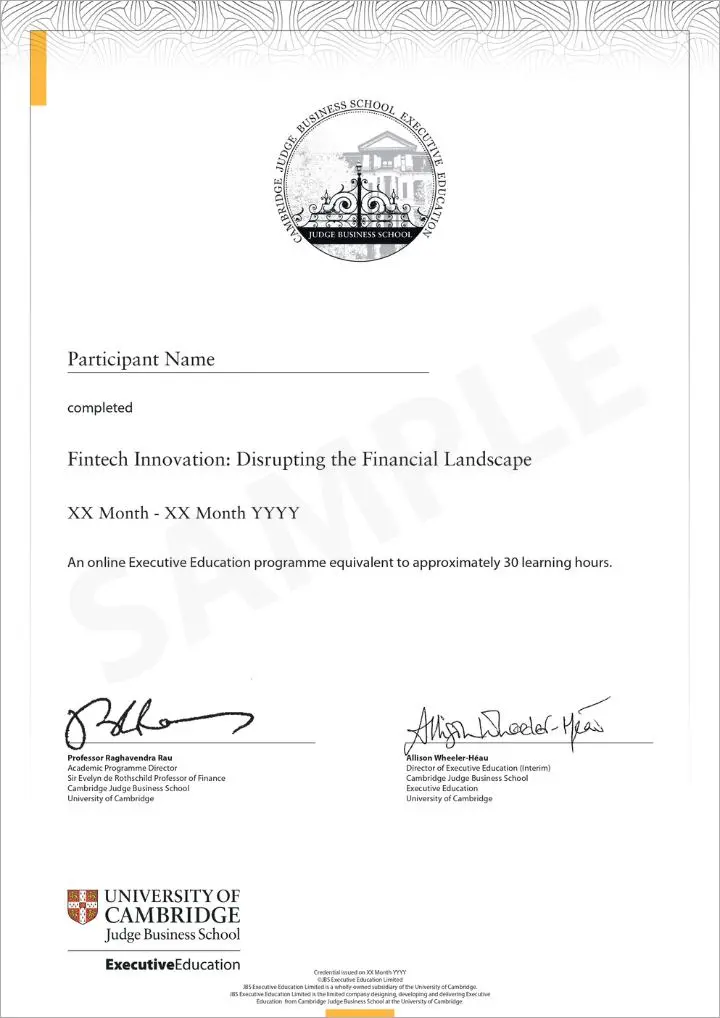
Certificate
Upon successful completion of the programme, participants will be awarded a digital certificate of completion by Cambridge Judge Business School Executive Education.
Please note that this programme can be incorporated into the completion of the Cambridge General Management Certificate of Achievement (GMCA). It will be credited as an "in-person" two-day programme for the purpose of meeting the GMCA requirements. If you require more details on the GMCA and wish to speak to our advisers, please contact executive.education@jbs.cam.ac.uk.
Note: After successful completion of the online programme, your verified digital certificate will be emailed to you in the name you used when registering for the programme. All certificate images are for illustrative purposes only and may be subject to change at the discretion of Cambridge Judge Business School Executive Education.
FAQs
The Programme
How do I know if this programme is right for me?
After reviewing the information on the programme landing page, we recommend you submit the short form above to gain access to the programme brochure, which includes more in-depth information. If you still have questions about whether this programme is a good fit for you, please email us on the email address mentioned above learner.success@emeritus.org, and a dedicated programme adviser will follow up with you very shortly.
Are there any prerequisites for this programme?
Some programmes do have prerequisites, particularly the more technical ones. This information will be noted on the programme landing page, as well as in the programme brochure. If you are uncertain about programme prerequisites and your capabilities, please email us at the ID mentioned above.
Note that, unless otherwise stated on the programme web page, all programmes are taught in English, and proficiency in English is required.
What is the typical class profile?
More than 50% of our participants are from outside the United States. Class profiles vary from one cohort to the next, but generally, our online certificates draw a highly diverse audience in terms of professional experience, industry and geography—leading to a very rich peer learning experience.
What other dates will this programme be offered in the future?
Check back at this programme web page or email us to inquire if future programme dates or the timeline for future offerings have been confirmed yet.
The Learning Experience
How much time is required each week?
Each programme includes an estimated learner effort per week. This is referenced at the top of the programme landing page under the Duration section, as well as in the programme brochure, which you can obtain by submitting the short form at the top of this web page.
How will my time be spent?
We have designed this programme to fit into your current working life as efficiently as possible. Time will be spent among a variety of activities, including:
Engaging with recorded video lectures from faculty
Attending webinars and office hours, as per the specific programme schedule
Reading or engaging with examples of core topics
Completing knowledge checks/quizzes and required activities
Engaging in moderated discussion groups with your peers
Completing your final project, if required
The programme is designed to be highly interactive while also allowing time for self-reflection and to demonstrate an understanding of the core topics through various active learning exercises. Please email us if you need further clarification on programme activities.
What is it like to learn online with the learning collaborator, Emeritus?
More than 300,000 learners across 200 countries have chosen to advance their skills with Emeritus and its educational learning partners. In fact, 90% of the respondents of a recent survey across all our programmes said that their learning outcomes were met or exceeded.
All the contents of the programme would be made available to students at the commencement of the programmecourse. However to ensure the programme delivers the desired learning outcomes, the students may appoint Emeritus to manage the delivery of the programme in a cohort-based manner, the cost of which is already included in the overall programme fee.
A dedicated programme support team is available 24/5 (Monday to Friday) to answer questions about the learning platform, technical issues or anything else that may affect your learning experience.
How do I interact with other programme participants?
Peer learning adds substantially to the overall learning experience and is an important part of the programme. You can connect and communicate with other participants through our learning platform.
Certification
What are the requirements to earn the certificate?
Each programme includes an estimated learner effort per week, so you can gauge what will be required before you enrol. This is referenced at the top of the programme landing page under the Duration section, as well as in the programme brochure, which you can obtain by submitting the short form at the top of this web page. All programmes are designed to fit into your working life.
This programme is scored as a pass or no-pass. Participants must complete the required activities to pass and obtain the certificate of completion. Some programmes include a final project submission or other assignments to obtain passing status. This information will be noted in the programme brochure. Please email us if you need further clarification on any specific programme requirements.
What type of certificate will I receive?
Upon successful completion of the programme, you will receive a smart digital certificate. The smart digital certificate can be shared with friends, family, schools or potential employers. You can use it on your cover letter or resume and/or display it on your LinkedIn profile.
The digital certificate will be sent approximately two weeks after the programme, once grading is complete.
Can I get the hard copy of the certificate?
No, only verified digital certificates will be issued upon successful completion. This allows you to share your credentials on social networking platforms, such as LinkedIn, Facebook and X (formerly Twitter).
Do I receive alumni status after completing this programme?
No, there is no alumni status granted for this programme. In some cases, there are credits that count towards a higher level of certification. This information will be clearly noted in the programme brochure.
How long will I have access to the learning materials?
You will have access to the online learning platform and all the videos and programme materials for 24 months following the programme start date. Access to the learning platform is restricted to registered participants per the terms of agreement.
Technical Requirements
What equipment or technical requirements are there for this programme?
Participants will need the latest version of their preferred browser to access the learning platform. In addition, Microsoft Office and a PDF viewer are required to access documents, spreadsheets, presentations, PDF files and transcripts.
Do I need to be online to access the programme content?
Yes, the learning platform is accessed via the internet, and video content is not available for download. However, you can download files of video transcripts, assignment templates, readings, etc. For maximum flexibility, you can access programme content from a desktop, laptop, tablet or mobile device. Video lectures must be streamed via the internet, and any livestream webinars and office hours will require an internet connection. However, these sessions are always recorded, so you can view them later.
Payment Process
Can I still register if the registration deadline has passed?
Yes, you can register up until seven days past the published start date of the programme without missing any of the core programme material or learnings.
What is the programme fee, and what forms of payment do you accept?
The programme fee is noted at the top of this programme web page and usually referenced in the programme brochure as well.
Flexible payment options are available (see details below as well as at the top of this programme web page next to FEE).
If you apply by an early deadline, you may receive a programme fee benefit. If you believe you may qualify for other discounts, please check with your programme adviser to confirm the applicable discount that will provide the greatest benefit and if there are specific terms and conditions for use. For more information, please connect with a learning adviser or email learner.success@emeritus.org.
What if I don’t have a credit card? Is there another method of payment accepted?
Yes, you can do the bank remittance in the programme currency via wire transfer or debit card. Please contact your programme adviser, or email us for details.
I was not able to use the discount code provided. Can you help?
Yes! Please email us with the details of the programme you are interested in, and we will assist you.
How can I obtain an invoice for payment?
Please email us your invoicing requirements and the specific programme you’re interested in enroling in.
Is there an option to make flexible payments for this programme?
Yes, the flexible payment option allows a participant to pay the programme fee in instalments. This option is made available on the payment page and should be selected before submitting the payment.
How can I obtain a W9 form?
Please connect with us via email for assistance.
Who will be collecting the payment for the programme?
Emeritus collects all programme payments, provides learner enrolment and programme support and manages learning platform services.
Are there any restrictions on the types of funding that can be used to pay for the programme?
Programme fees for Emeritus programmes with Cambridge Judge Business School Executive Education may not be paid for with (a) funds from the GI Bill, the Post-9/11 Educational Assistance Act of 2008 or similar types of military education funding benefits or (b) Title IV financial aid funds.
Refund Policy
What is the programme refund and deferral policy?
For the programme refund and deferral policy, please click the link here.
Accessibility
How does Emeritus support accessibility for learners?
Emeritus is committed to making high-quality education accessible and affordable to individuals, companies and governments around the world. If you have questions about accessibility or would like to discuss available support options before enrolling, please contact accessibility@emeritus.org. For more information about our accessibility practices, please review our Accessibility Policy here.
Didn't find what you were looking for? Write to us at learner.success@emeritus.org or Schedule a call with one of our Programme Advisers or call us at +44 203 479 4043 (UK) / +1 315 819 0707(US) / +65 3163 8580 (SG)